Open Theism
Definition
Open theism refers to any philosophy which claims that there is a supreme creator of the universe who does not foreknow the outcome of human choices.
Keywords: Open Theism, Philosophies, Philosophy, Rational, Assumption, Contradiction, Reasoning, False, Deductive, Argument From Reason.
Veracity
Open-theistic claims are false .
Proof
Simplified
Humans assume that all contradictions are false. Any worldview that does not allow for this assumption to be rationally justified is deductively false.
Premise 1: If the author of our initial assumptions about time is not also the author of time, our assumptions about time are without reason.
Premise 2: The god of open theism is not the author of time.
Conclusion: Therefore, if the god of open theism is the author of our assumptions about time, our assumptions about time are without reason.
Humans assume that time, like everything else, is non-contradictory. Under open theism, there can ultimately be no reason to hold to this assumption, making it an irrational assumption. This makes open theism deductively false.
In depth
Humans assume that all contradictions are false. Any worldview that does not allow for this assumption to be rationally justified is deductively false.
A. The god of open theism did not design all present conditions.
Premise 1: Anything that does not foreknow all present conditions did not design all present conditions.
Premise 2: The god of open theism does not foreknow all present conditions.
Conclusion: Therefore, the god of open theism did not design all present conditions.
B. The god of open theism is not the rational author of the present.
Premise 1: Anything that did not design all present conditions is not the rational author of the present.
Premise 2: The god of open theism did not design all present conditions (from A above).
Conclusion: Therefore, the god of open theism is not the rational author of the present.
C. The god of open theism is not the rational author of time.
Premise 1: Anyone who is not the rational author of the present is not the rational author of time.
Premise 2: The god of open theism is not the rational author of the present (from B above).
Conclusion: Therefore, the god of open theism is not the rational author of time.
D. If open-theistic claims are true, there is no rational author of time.
Premise 1: If there existed a rational author of time, it would be a god that is not the god of open theism.
Premise 2: If open-theistic claims are true, the only god or gods are open theist gods.
Conclusion: Therefore, if open-theistic claims are true, there is no rational author of time.
E. If open-theistic claims are true, time itself is not capable of rational thought.
Premise 1: If time itself were capable of rational thought, it would be a god other than the god of open theism.
Premise 2: If open-theistic claims are true, the only god or gods are open-theistic.
Conclusion: Therefore, if open-theistic claims are true, time itself is not capable of rational thought.
F. If open-theistic claims are true, no one can be rationally justified in having beliefs about time.
Premise 1: Any being not sovereign over [x] cannot be rationally justified in having beliefs about [x] without the non-contradictory nature of [x] being explicitly predefined by the rational author of [x], or without [x] itself being capable of rational thought.
Premise 2: If open-theistic claims are true, there is no rational author of time and time itself is not capable of rational thought (from D, E above).
Conclusion: Therefore, if open-theistic claims are true, no one can be rationally justified in having beliefs about time.
G. If open-theistic claims are true, humans are not rationally justified in drawing conclusions about things in the future.
Premise 1: If open-theistic claims are true, no one can be rationally justified in having beliefs about time (from F above).
Premise 2: Having beliefs about time is necessary for humans to draw conclusions about things in the future.
Conclusion: Therefore, if open-theistic claims are true, humans are not rationally justified in drawing conclusions about things in the future.
H. If open-theistic claims are true, humans are not rationally justified in drawing conclusions about things in the present.
Premise 1: If open-theistic claims are true, no one can be rationally justified in having beliefs about time (from F above).
Premise 2: Having beliefs about time is necessary for humans to draw conclusions about things in the present.
Conclusion: Therefore, if open-theistic claims are true, humans are not rationally justified in drawing conclusions about things in the present.
I. If open-theistic claims are true, humans are not rationally justified in drawing conclusions about things in the past.
Premise 1: If open-theistic claims are true, no one can be rationally justified in having beliefs about time (from F above).
Premise 2: Having beliefs about time is necessary for humans to draw conclusions about things in the past.
Conclusion: Therefore, if open-theistic claims are true, humans are not rationally justified in drawing conclusions about things in the past.
J. If open-theistic claims are true, no human conclusions are rationally justified.
Premise 1: All human conclusions are about things in the past, present, or future.
Premise 2: If open-theistic claims are true, humans are not rationally justified in drawing conclusions about things in the past, present, or future (from G, H, I above).
Conclusion: Therefore, if open-theistic claims are true, no human conclusions are rationally justified.
Humans assume that time, like everything else, is non-contradictory. Under open theism, there can ultimately be no reason to hold to this assumption, making it an irrational assumption.
This Argument from Reason demonstrates that open theism is deductively false.
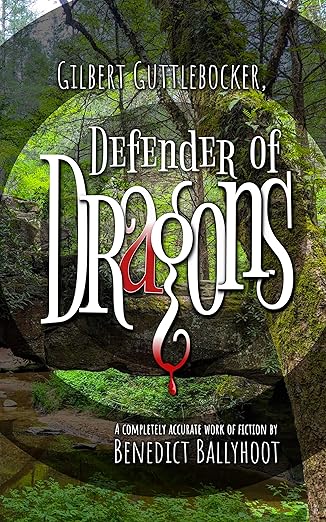
Gilbert Guttlebocker, Defender of Dragons
Riveting, yet absurd; romantic, yet innocent; Gilbert Guttlebocker, Defender of Dragons is a little Roald Dahl, a little Harry Potter, and a little Chronicles of Narnia, all rolled into one. Timothy McCabe collaborates with the great Benedict Ballyhoot to bring you the novel of the century!
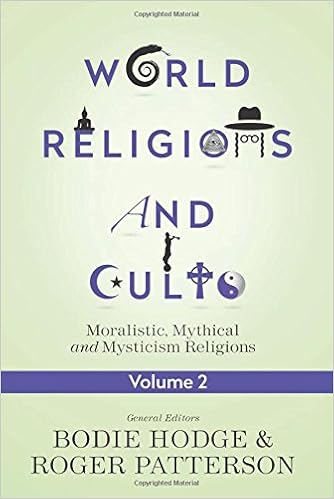
In Printed Form
Along with numerous other authors including Don Landis, Bodie Hodge and Roger Patterson, Timothy McCabe contributes analyses of various world religions and cults in this volume from Master Books.
Other Writings
"What is your standard of truth? How do you determine what is true?"
1. God Himself is the standard of truth. (John 14:6; Exodus 34:6; 2 Samuel 7:28; Psalm 25:10; Isaiah 65:16; Ephesians 4:21; Titus 1:2; 1 John 5:6) 2. Because of this, when God reveals things to us, we know that what He reveals is true. The Bible stands as an authoritative communication to us from God Himself, and we can often discern truth or falsehood simply by comparing a particular claim with Biblical revelation.
Continue reading...
"If God has a "divine plan" for everyone, then does that mean he controls humans and animals to meet his plan?"
Definitely. The Biblical God is in complete control of everything. In the book of Ephesians, we see that God "works all things after the counsel of His will" (Ephesians 1:11; Romans 8:28; 1 Corinthians 12:6; Psalm 135:6).
Continue reading...
"Are all presuppositions equally valid? If not, how does one determine which are more valid than others?"
Internal consistency is the most common method I know of for determining the truth value of presuppositions. The test of internal consistency is what presuppositional reasoning is all about. If, for example, a view presupposes "A" and "not-A" at the same time and in the same way, then, in that worldview, reasoning, knowledge, learning, meaning, morality, science, mathematics -- everything -- becomes utterly incoherent.
Continue reading...